Descrizione Opera / Biografia
Maria Węgrzyniak - Szczepkowska was born in 1954 in Warsaw. He is a historian of philosophy by education. Her artistic activity related to unique fabric was reactivated in 2015 after several dozen years of break. She made her debut with traditional religious tapestries. Today, its characteristic, original fabrics are a combination of traditional weaving techniques with the innovative use of non-standard materials - electric cables, paper, clothing, leather and other raw materials. Tapestries usually touch upon the themes of interpersonal, social and cultural relations, and above all they treat the existential condition of a man - his place, history and individuality in the surrounding world. Original technical solutions and a subtle selection of topics were awarded in the MUZA competition - Magdalena Abakanowicz 2015 and in the 5th National Gobelin Contest of 2015. Her previous works have been submitted to the collections of the Primate’s Institute, Cardinal Stefan Wyszynski and are located in the Primate Chapel in Choszczówka near Warsaw.
2017 participation in the post-competition exhibition of the finalists of the YICCA competition in Rome.
2016-2019 - Individual and collective exhibitions.
DRESS
Faith is crossing the border between the visible and the invisible world.
Visible things point to the invisible reality, they are like its trace.
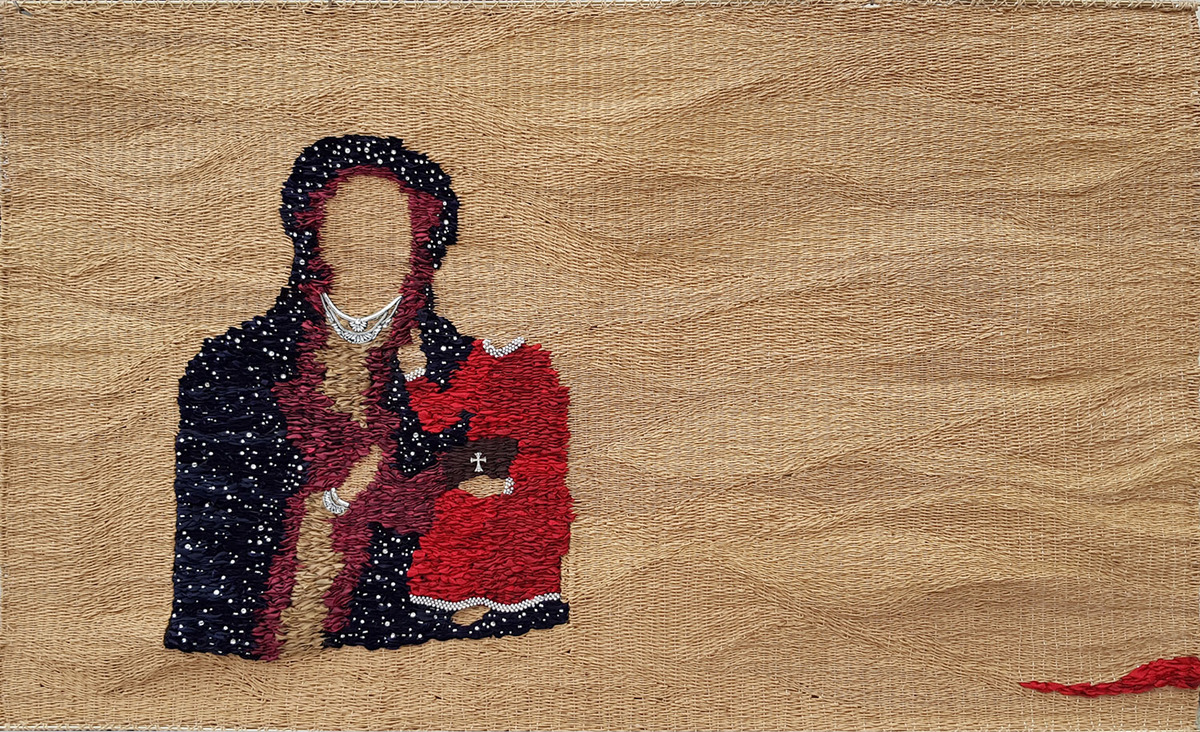
Looking at the dress for the icon of Our Lady of Czestochowa at the first moment we ask ourselves: What is this? Who is this dress for? Why is there no person?
Recognizing the outlines of the figure, we remind ourselves of the icon of Our Lady of Częstochowa.
Then the reflection may arise in us - does this icon, which has so many hidden meanings (religious, historical, patriotic, cultural, social etc.), has ever existed for me, and maybe it has any meaning today?
If so, are there any things that connect me, situations or perhaps a living relationship with Mary, the Mother of Christ, which this icon represents?
Another aspect is to notice that the real-existing reality is composed of elements available to our sensory cognition (visible elements) and invisible elements, to which we can reach only by means of intellect or faith, as if after the tracks. The dress is such a trail.
The boundary between these two orders is only theoretical.